Showing posts with label peace. Show all posts

25 September 2011

Tranquil in darkness

Glowing ember
Burning hot
Burning slow.

It was late Friday evening when I drove home after the movies with a few friends, the atmosphere was calm and serene, unrushed as the weekend was only an hour away. The traffic still looked ridiculously bad going downtown but the drive back to Subang was of its normal pace with most people already home and there was no traffic jam to slow things down.
I might be driving on the wrong side of the road there...

I enjoy driving home in the quiet of the night with slow music from the radio to unwind after a busy day - there is something calming about the night that gladdens the heart.

I had Sarah McLachlan's  Do What You Have To Do on via the Bluetooth player during a short period of congestion in front of the PJ Hilton. Her voice filled the dark interior of the car, the quietness cocooned within, lit only by the red dashboard displays. The air-conditioner was blowing gently - not too cold, just right.

Just her voice and the piano, singing about the conflict between the heart and the mind to let go of something so dear.

Whilst I'm nowhere there at the moment, sharing the emotions that literally oozes from the song, but she seems to capture the very essence of the dilemma that one faces when they are at the crossroads that we will all come to many times at various stages of our lives.

"Black Arial 16 bold or Tahoma 17 blue?"
 Instead I was mesmerized by the three lines describing ember that is burning, literally seeing it in my mind, the orange-yellow glow, barely lighting up a monochromatic background. Combine that with the slow tempo of the piano and the hypnotic quality of the singer's voice, I was literally at peace.

The week before I had Keiko Matsui's acoustic version of Water Lily, the tinkle of the ivory hitting the strings as her fingers danced over their black and white keys. It seemed to massage the soul like the gentle fingers of a masseuse loosening the knots of tired muscles. I listened to every note and savour them individually and together, creating the wonderful melody that made the piano such a soothing instrument.

Perhaps this is why I like small or one-to-one interaction with people; I can listen to them with my fullest attention, taking in what is being said without the distractions and connect with them, to be on the same wavelength. It's like a duet, two individuals playing the same song.

Not sure how but this came out as one of the results in Google search.
 Maybe because of this I happen to become a person that people are not afraid of confiding to. I have sat in front of many who told me of their innermost secrets, anger and fear, sometimes accompanied by tears that at times would sometimes cut my own heart because I 'feel' their words, not necessarily understanding it the way that only they themselves can. Sometimes all they needed is someone to listen to what their heart is crying out, not necessarily to seek in opinion or solution.

As the car cruised smoothly down the highway, I thanked God the weekend is here again.

6 July 2010

A Future Worth Believing In

An old article but meaningful nonetheless.

--

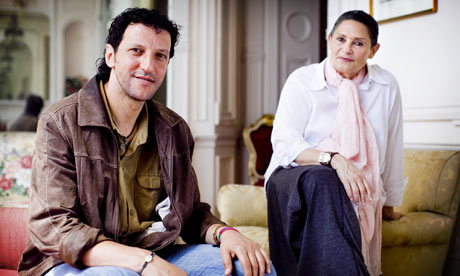
She's Israeli, he's an Arab. War has made them like mother and son

Sarfraz Manzoor
The Observer, Sunday 10 May 2009


http://www.guardian.co.uk/world/2009/may/10/palestine-israel-peace-campaigners

It is a friendship as remarkable as it is unlikely: Robi Damelin is a 65-year-old Jewish grandmother whose son, David, served in the Israeli army; Ali Abu Awwad, 37, is a former Palestinian revolutionary who joined the first intifada as a teenager and was later sentenced to 10 years in an Israeli prison – he served four. David Damelin was killed by a Palestinian sniper seven years ago; two years before that, Awwad's brother, Youssef, 32, was shot and killed by an Israeli soldier.

These were two deaths that might have been expected to contribute to the cycle of violence and hatred that characterises the Israeli-Palestinian conflict. Instead, for the past five years Damelin and Awwad have travelled the world, speaking together at mosques, synagogues, parliaments and public meetings to spread the message that there will only be peace in the Middle East when there is reconciliation. Last week they brought that message to Britain, attending an Amnesty International event and speaking to an audience of Muslims at the London Central Mosque.

In the back of an east London coffee shop, the two reflected on a relationship that both hope may prefigure a different future for Israel and Palestine. "If someone had said to me when I was 15 that I would have someone like Robi as a friend," said Awwad, "in my wildest dream I would not have imagined it. But when I met her she began to tell me about her relationship to her sons and how the killing of David affected her relationship with her other son.

"I felt this very deeply because my mother didn't pay much attention to me after the death of my brother, because she was closer to him than me. We made a connection."

That connection was made through the Parents Circle, a remarkable organisation that brings together Israelis and Palestinians who have lost immediate members of their family in the conflict. The circle, also known as the Bereaved Family Forum, was set up by Yitzhak Frankenthal, an Orthodox Jew whose 19-year-old son had been killed by Hamas activists. Today it has more than 500 members who have all rejected violence, hatred or revenge as a means to solve the conflict.

"At first I didn't want to mix with bereaved parents," admitted Damelin, "but I gradually realised that the only hope for progress was to recognise the face of the conflict – that was why when they told me that David had been killed my first instinct was to say I did not want anyone killed in the name of my child. I did not want revenge."

It was through the Parents Circle that she met Awwad, whose brother had been shot in the head. "When I learned about my brother's death I was just so full of anger," he recalled. "But I realised that for me to survive I needed to meet someone from the other side who could understand me – so when I met Robi I met someone who gave me hope."

It is a hope which both Damelin and Awwad are keen to stress is not based on pretending there are no disagreements, but is instead rooted in the idea that the first step towards reconciliation is to recognise thesuffering of the other side. "If you are pro-Palestinian or pro-Israel you are not helping us," said Damelin. "You are just feeling good about yourself."

"For some Muslims, the situation in Palestine is theoretical," said Awwad. "Maybe that is why there is more militancy among British Muslims than there is in Palestine, and it's the same with American Jews who seem less likely to compromise than Israelis. Why? Because they are not the ones who have to stand at roadblocks every day, it isn't their children, their sons and brothers who are dying, so it is easy for them to say they do not want to compromise."

Compromise, Damelin and Awwad believe, is possible; they are both hopeful for the future. Damelin – who was born in South Africa – suggested that the Bereaved Families Forum could inspire a future Truth and Reconciliation Commission in Israel and Palestine.

"I remain an optimist," she said. "After all, if you had told me in 1967 when I left South Africa that one day whites and blacks would sit together in the same room I would have thought you were mad." As mad perhaps as if she had been told that a Palestinian ex-revolutionary would become one of her closest friends. "It is very difficult to give away things that belong to your child," she said in a quiet voice. "It is like admitting that they will not come back.

"But I had this lovely jacket that a relation had brought David – a beautiful jacket – and Ali and David are the same height and build, so I chose to give that jacket to Ali, and I am happy I did. It was the right thing to have done."

"Whatever you do, you cannot replace the child a mother has lost," said Awwad. "Youssef and David will never come back again, but at least you find something to live for. Wherever I go I carry a picture of David with me, it's in my bag with me right now."

The tea has been drunk and it is almost time to leave. It must be a strange experience, continually and publicly reopening the wounds of personal loss in the hope that it may eventually inspire peace. "This is my life, I don't have a choice any more," said Damelin, when asked how long she imagined she would continue travelling. "I have a motherly relationship with Ali. I worry about him, I care about what happens; maybe I am a little overprotective about him."

There is a palpable sense that she and Awwad complete the other in some way, offering some consoling echo of what has been lost. Theirs is a friendship that only appears unusual when individuals are reduced to labels and tribes; and yet when Ali Abu Awwad and Robi Damelin are viewed not as Israelis and Palestinians, Jews and Muslims, but rather as a son and mother, the relationship begins not to feel unlikely at all.

"I have found in Robi what I didn't get from my own mother," said Awwad. "She knows what kind of clothes I like, the people I like, and she advises me on all these things. She even knows what food I like."

"Shrimps," said Damelin, laughing. "He is addicted to shrimps."

10 January 2010

Have we forgotten?

This entry was originally much longer than this because of the many things in my mind regarding the current event that is happening right now in the country, but I decided to just make a few quotes from a movie, a holy book and a treatise, to illustrate what I think about the whole issue.

"I put no stock in religion. By the word religion I have seen the lunacy of fanatics of every denomination be called the will of God. I've seen too much religion in the eyes of murderers. Holiness is in right action, and courage on behalf of those who cannot defend themselves, and goodness. What God desires is (here points to head - the mind) and here (points to heart - soul) and what you decide to do every day will make you a good man...or not".

Hospitaller Knight, commenting on the movie hero's Balian's statement that he lost his religion and found no respite.

"None of us know our end really, or what hand will guide us there. A King may move a man, a father may claim a son. That man can also move himself. And only then does that man truly begin his own game. Remember that howsoever you are played, or by whom, your soul is in your keeping alone. Even though those who presume to play you be kings or men of power. When you stand before God, you cannot say 'but I was told by others to do thus' or that 'virtue was not convenient at the time.' This will not suffice. Remember that".

King Baldwin IV, during his first meeting with Balian at the palace of Jerusalem.

One of the teachers of the law came and heard them debating. Noticing that Jesus had given them a good answer, he asked him, "Of all the commandments, which is the most important?". "The most important one," answered Jesus, "is this: 'Hear, O Israel, the Lord our God, the Lord is one.Love the Lord your God with all your heart and with all your soul and with all your mind and with all your strength.'The second is this: 'Love your neighbor as yourself.'There is no commandment greater than these." "Well said, teacher," the man replied. "You are right in saying that God is one and there is no other but him. To love him with all your heart, with all your understanding and with all your strength, and to love your neighbor as yourself is more important than all burnt offerings and sacrifices." Now when Jesus saw that he answered wisely, He said to him, “You are not far from the kingdom of God.” But after that no one dared question Him.

Mark 12:28-34, New King James Bible

"And do not dispute with the followers of the Book except by what is best, except those of them who act unjustly, and say: We believe in that which has been revealed to us and revealed to you, and our God and your God is One, and to Him do we submit".

al-Quran 29:46 - translation by Muhammad Habib Shakir

"In the name of Allah, the Most Merciful, the Beneficent. This is what the slave of Allah, Umar b.Al-Khattab, the Amir of the believers, has offered the people of Illyaa’ of security granting them Amaan (protection) for their selves, their money, their churches, their children, their lowly and their innocent, and the remainder of their people. Their churches are not to be taken, nor are they to be destroyed, nor are they to be degraded or belittled, neither are their crosses or their money, and they are not to be forced to change their religion, nor is any one of them to be harmed. No Jews are to live with them in Illyaa’ and it is required of the people of Illyaa’ to pay the Jizya, like the people of the cities. It is also required of them to remove the Romans from the land; and whoever amongst the people of Illyaa’ that wishes to depart with their selves and their money with the Romans, leaving their business and crosses behind, then their selves, their trading goods and their children are secure until they reach their destination. Upon what is in this book is the word of Allah, the covenant of His Messenger, of the Khulafaa’ and of the believers if they (the people of Illyaa’) gave what was required of them of Jizya. The witnesses upon this were Khalid ibn Al-Walid, 'Amr ibn al-'As, Abdur Rahman bin Awf and Muawiyah ibn Abi Sufyan. Written and passed on the 15th year (after Hijrah)".

Al-'Uhda Al-'Umariyya, 'Convenant of Caliph Umar al-Khattab I'